> ## Documentation Index
> Fetch the complete documentation index at: https://tashfiq.mintlify.site/llms.txt
> Use this file to discover all available pages before exploring further.
# Introduction
> Charter scores every repository's AI-agent readiness — offline, deterministic, and actionable.
Teams adopting coding agents don't fail because the model is bad — they fail because the repo isn't ready. Charter measures that readiness in under 2 seconds and tells you exactly what to fix.
 ## Score zones
| Score | Zone | Meaning |
| --------- | -------------- | ------------------------------------------------ |
| 🟢 80–100 | **Ship-ready** | Repo is well-configured for agent-assisted work |
| 🟡 60–79 | **Needs work** | Active findings that limit agent effectiveness |
| 🔴 50–59 | **Blocked** | One or more Blocker-severity findings present |
| 🔴 0–49 | **Critical** | Raw secret detected in an agent-visible location |
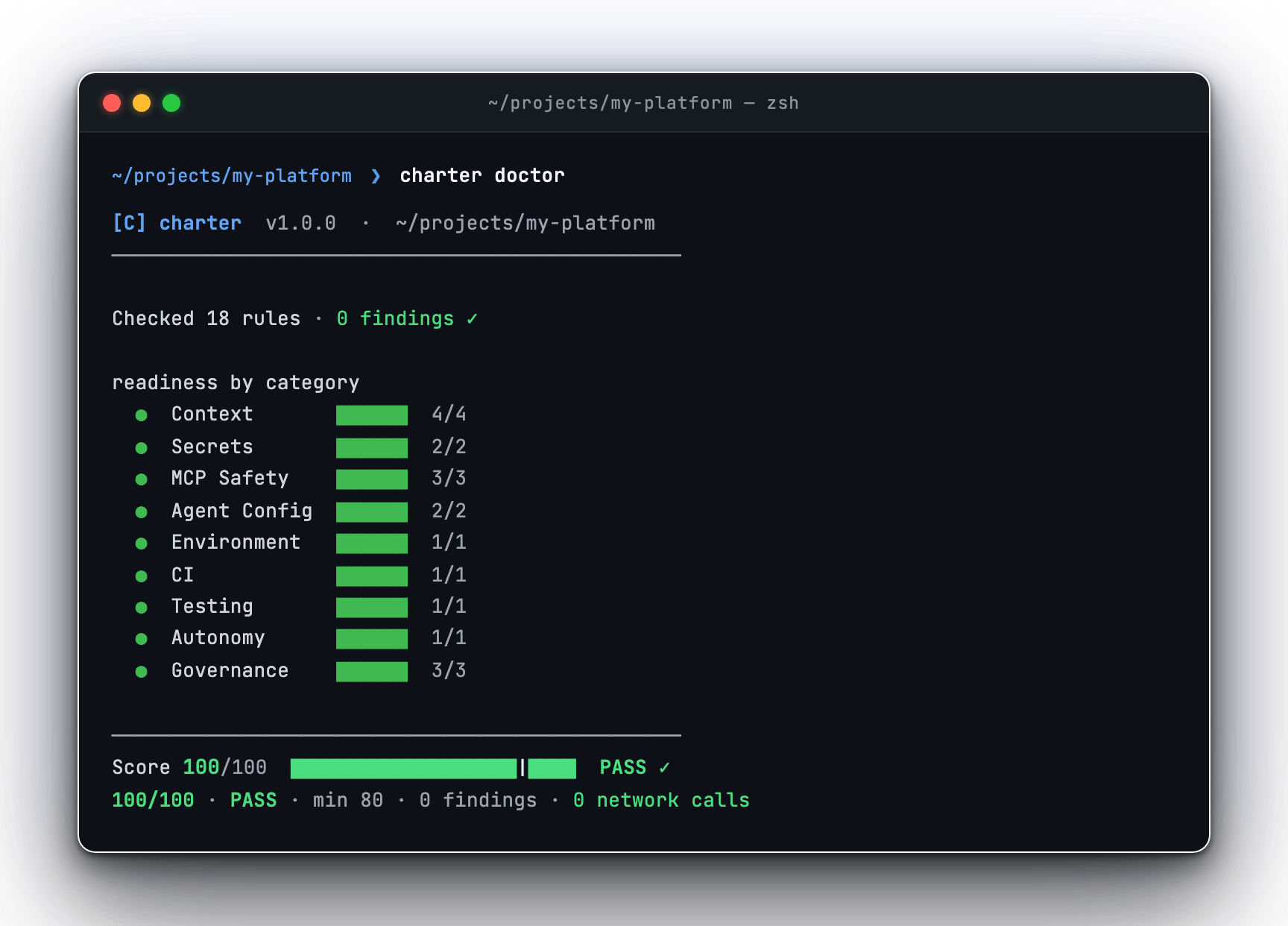
The score formula is public: `max(0, 100 − B×20 − H×10 − M×4 − L×1)`, where B/H/M/L are Blocker, High, Medium, and Low finding counts. Hard caps override the formula: any secret finding locks the score at ≤49; any blocker finding locks it at ≤59.
## What Charter evaluates
Can the agent orient itself? Charter checks that an AGENTS.md exists, stays current, declares edit boundaries, and fits within a context window.
Is the repo safe to operate on? Charter checks for raw secrets in agent-visible files, unpinned MCP servers, and dangerous hook commands.
Can the agent run and verify its work? Charter checks for automated tests, a discoverable verification command, a reproducible toolchain, and a CI gate.
Governance cuts across all three axes: suppression entries are audited for reason, ownership, and accumulation rate.
## What Charter is not
Charter does not inspect your code for bugs, style violations, or logic errors. It evaluates the repo's structural readiness for agents — the scaffolding around the code, not the code itself.
Charter does not audit dependency versions or CVEs. Use Dependabot, Snyk, or similar tools for supply-chain vulnerability scanning. Charter's supply-chain checks are limited to MCP server pinning and provenance.
Charter is a static, offline scanner. It does not observe agents as they run, intercept tool calls, or detect misbehavior at runtime.
Charter detects raw secrets in agent-visible locations and tells you to move them. It does not manage, rotate, or store secrets. Use a dedicated secrets manager for that.
Charter scans the current working tree only. It does not inspect git history for secrets or configuration drift over time.
## How it works
`charter doctor` scans the repo statically — no network calls, no LLM calls, no data sent anywhere. It produces a score from 0–100, emits structured findings with rule IDs and remediation guidance, and exits non-zero when the score falls below a threshold you control.
`charter fix` applies safe diff-first repairs for findings Charter knows how to fix. Every repair shows a unified diff before writing. Secrets and dangerous commands are never auto-fixed.
The score, the formula, and the rule set are all public and stable within a major version. Teams can use the score as a local signal, a pre-commit gate, and a CI requirement — and the number means the same thing in all three contexts.
## Start here
Get a real Charter score on your repo in under 5 minutes.
The three readiness axes, the scoring formula, and the fix engine.
All 18 rules — what each checks and how to remediate it.
Run Charter in CI and gate pull requests on agent-readiness.
## Score zones
| Score | Zone | Meaning |
| --------- | -------------- | ------------------------------------------------ |
| 🟢 80–100 | **Ship-ready** | Repo is well-configured for agent-assisted work |
| 🟡 60–79 | **Needs work** | Active findings that limit agent effectiveness |
| 🔴 50–59 | **Blocked** | One or more Blocker-severity findings present |
| 🔴 0–49 | **Critical** | Raw secret detected in an agent-visible location |
The score formula is public: `max(0, 100 − B×20 − H×10 − M×4 − L×1)`, where B/H/M/L are Blocker, High, Medium, and Low finding counts. Hard caps override the formula: any secret finding locks the score at ≤49; any blocker finding locks it at ≤59.
## What Charter evaluates
Can the agent orient itself? Charter checks that an AGENTS.md exists, stays current, declares edit boundaries, and fits within a context window.
Is the repo safe to operate on? Charter checks for raw secrets in agent-visible files, unpinned MCP servers, and dangerous hook commands.
Can the agent run and verify its work? Charter checks for automated tests, a discoverable verification command, a reproducible toolchain, and a CI gate.
Governance cuts across all three axes: suppression entries are audited for reason, ownership, and accumulation rate.
## What Charter is not
Charter does not inspect your code for bugs, style violations, or logic errors. It evaluates the repo's structural readiness for agents — the scaffolding around the code, not the code itself.
Charter does not audit dependency versions or CVEs. Use Dependabot, Snyk, or similar tools for supply-chain vulnerability scanning. Charter's supply-chain checks are limited to MCP server pinning and provenance.
Charter is a static, offline scanner. It does not observe agents as they run, intercept tool calls, or detect misbehavior at runtime.
Charter detects raw secrets in agent-visible locations and tells you to move them. It does not manage, rotate, or store secrets. Use a dedicated secrets manager for that.
Charter scans the current working tree only. It does not inspect git history for secrets or configuration drift over time.
## How it works
`charter doctor` scans the repo statically — no network calls, no LLM calls, no data sent anywhere. It produces a score from 0–100, emits structured findings with rule IDs and remediation guidance, and exits non-zero when the score falls below a threshold you control.
`charter fix` applies safe diff-first repairs for findings Charter knows how to fix. Every repair shows a unified diff before writing. Secrets and dangerous commands are never auto-fixed.
The score, the formula, and the rule set are all public and stable within a major version. Teams can use the score as a local signal, a pre-commit gate, and a CI requirement — and the number means the same thing in all three contexts.
## Start here
Get a real Charter score on your repo in under 5 minutes.
The three readiness axes, the scoring formula, and the fix engine.
All 18 rules — what each checks and how to remediate it.
Run Charter in CI and gate pull requests on agent-readiness.